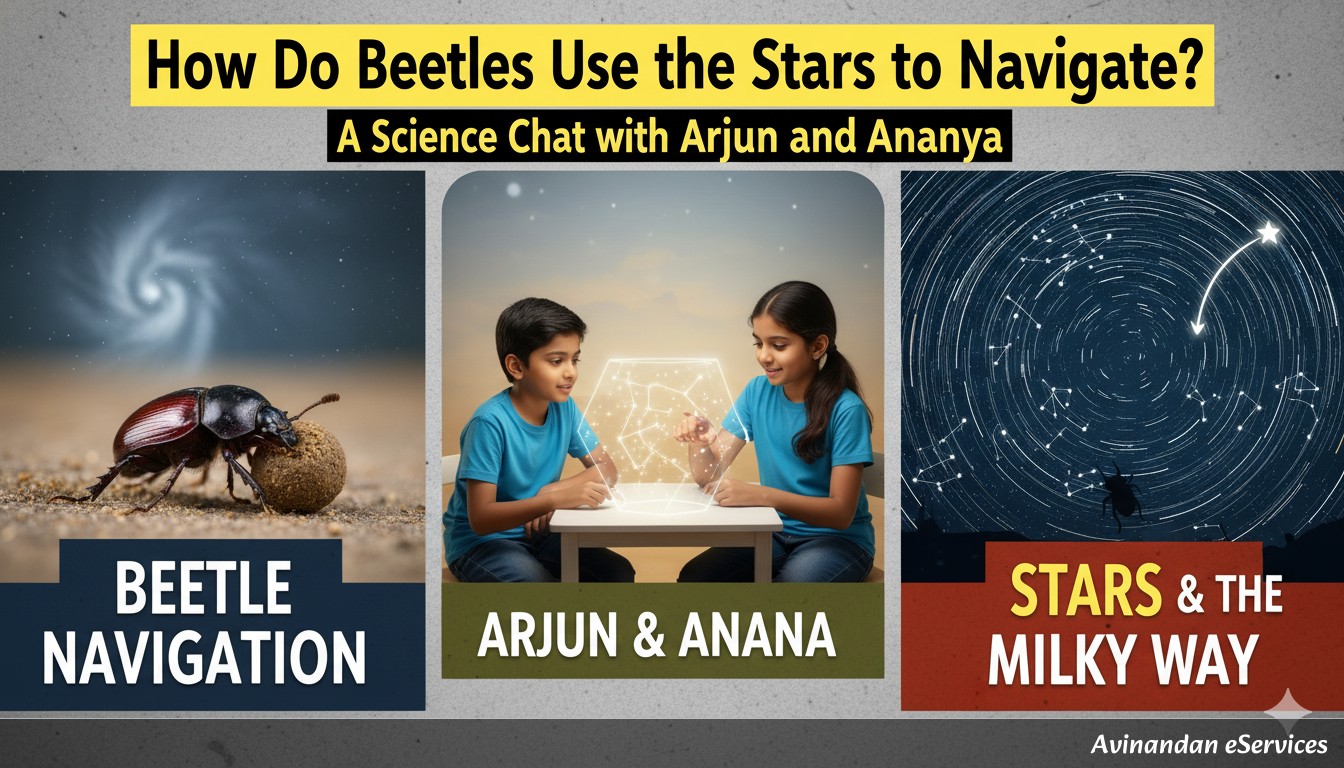
A Beetle's Guide to the Galaxy
Arjun: Ananya, I was reading a book about old sailors last night. They used to navigate their ships across huge oceans just by looking at the stars! They’d find the North Star and know which way to go. Do you think any animals are smart enough to do that?
Ananya: That’s a great question, Arjun! Many animals are amazing navigators. Birds, for example, can use the Earth’s magnetic field, the sun’s position, and even star patterns to migrate thousands of kilometers. But there’s another animal, a much smaller one, that uses the stars in a way that’s totally unique. And you’re probably not going to guess which one!
Arjun: Ooh, a mystery! Is it a wolf? Or maybe an owl, since they’re out at night?
Ananya: Good guesses, but nope! It’s… the dung beetle!
Arjun: A dung beetle?! No way! You’re kidding, right? They’re just little insects that roll around balls of… well, you know. How can they possibly navigate using the stars? Do they have tiny little telescopes?
Ananya: Haha, no telescopes! But they are brilliant astronomers in their own way. Specifically, a species of African dung beetle called Scarabaeus satyrus. They are nocturnal, so they do their work at night. Their whole mission is to find a fresh pile of dung, roll a piece into a perfect ball, and then get it away from the main pile as fast as possible.
Arjun: Why the big rush? Can’t they just enjoy their dung ball?
Ananya: The dung pile is a very competitive place! There are lots of other beetles who would love to steal a perfectly rolled ball instead of making their own. So, to escape the chaos and secure their food, a beetle needs to roll its ball away in the quickest, most efficient way possible: a perfectly straight line.
Arjun: Okay, that makes sense. If you wander around in circles, someone is definitely going to snatch your dinner. But how do stars help them roll in a straight line? The sky is full of them!
Ananya: That’s the most amazing part. They don’t look at one single star like the sailors did with the North Star. Their little compound eyes aren’t powerful enough to see tiny points of light. Instead, they look at the biggest band of light in the night sky: the Milky Way!
Arjun: Whoa! They use the entire galaxy? Our galaxy?
Ananya: Exactly! The Milky Way looks like a faint, hazy stripe of light stretched across the sky. The dung beetle uses this long stripe as a giant cosmic compass. As long as they keep that stripe of light at a constant angle to their body, they know they’re rolling in a straight line. It’s like using a giant celestial highway to keep yourself from veering off course.
Arjun: That is so cool! But how do scientists even know that? Did they follow a dung beetle for a whole night?
Ananya: They did something even cooler! A team of scientists in South Africa built a little arena for the beetles to roll their dung balls. But here's the clever part: they put this arena inside a planetarium—a special theatre where they can project the night sky onto the ceiling.
Arjun: A planetarium for beetles! That’s hilarious!
Ananya: It is! It allowed the scientists to control the sky. First, they showed the beetles a full, starry night sky with the Milky Way visible. The beetles had no trouble rolling their balls in a straight line. Then, the scientists turned off just the Milky Way, leaving all the individual stars. Suddenly, the beetles got lost! They started wandering and circling, unable to hold a straight path.
Arjun: Wow! So that proved it! They needed that big, bright stripe. They don't care about the Big Dipper or Orion's Belt, just the whole galaxy.
Ananya: Precisely. It’s the first time we’ve ever discovered an animal using the galaxy itself for navigation. To make sure, the scientists even put tiny cardboard hats on the beetles to block their view of the sky. As you’d expect, the hatted beetles couldn't find their way. This amazing discovery shows us that even creatures with brains smaller than a grain of rice have evolved incredible ways to understand and use the universe around them.
Arjun: So the beetles are using a feature of the universe that's billions of light-years away to roll a ball of poop a few meters. That's one of the coolest and weirdest things I've ever heard!
Ananya: Isn't it? It reminds us that there's amazing science happening everywhere, from the grandest scale of the galaxy down to the tiniest beetle on the ground. Nature is full of surprises.
So, What Did We Learn Today?
Ananya: Let's go over the main points about our galaxy-guiding beetles!
- Certain types of African dung beetles navigate at night using the stars to travel in a straight line.
- They need to move in a straight line to get their precious ball of dung away from other thieving beetles as quickly as possible.
- Instead of using individual stars, their small eyes use the bright, hazy band of the Milky Way galaxy as a giant celestial compass.
- Scientists proved this by observing the beetles in a planetarium, where they could turn the projection of the Milky Way on and off.
- This is the first known example of an animal using the entire galaxy for navigation, showing how incredibly inventive evolution can be!
Arjun: And it proves that you don't need a big brain to be a brilliant navigator. Next time I look up at the Milky Way, I’ll think about all the dung beetles using it as their roadmap. That's amazing!