Introduction to the Topic
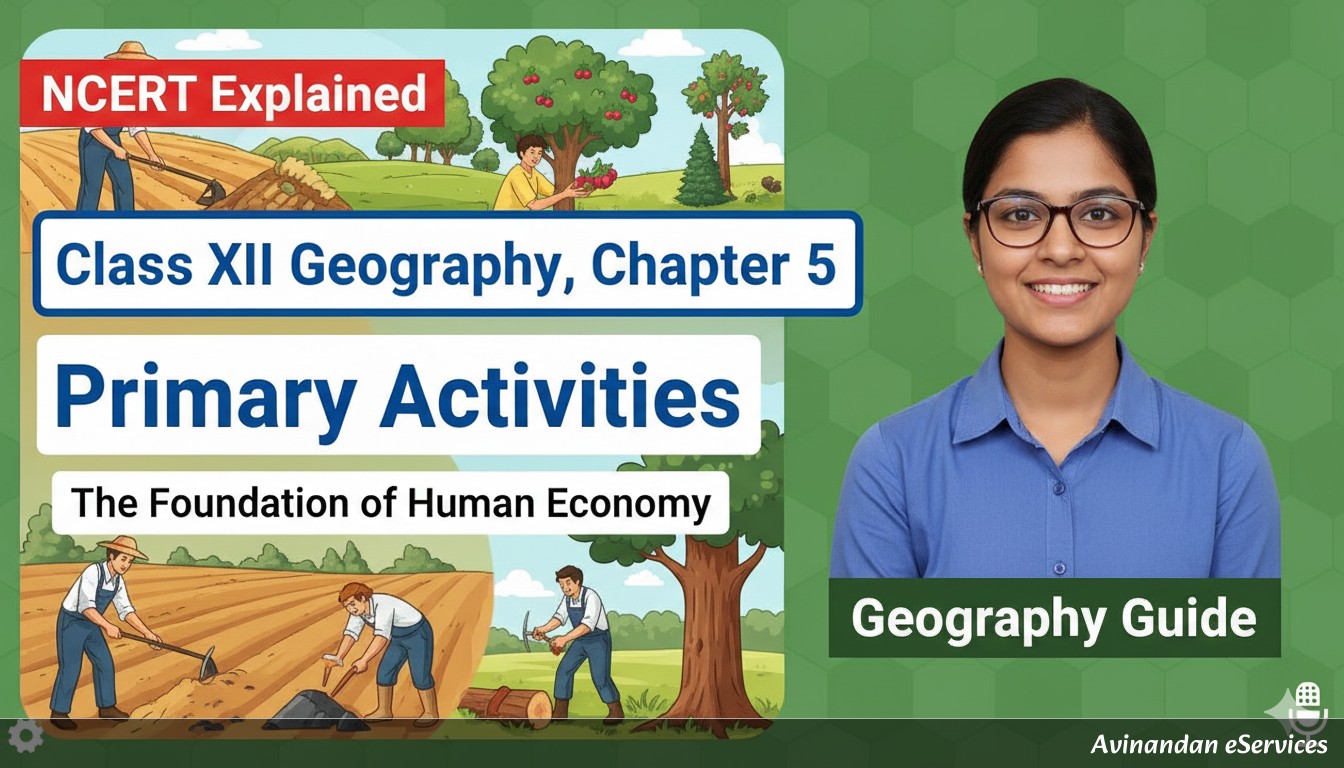
Welcome, students! Have you ever wondered where your food comes from? Or the raw materials for the clothes you wear and the device you're using right now? The answer lies in the very first step of the human economic ladder: Primary Activities. Chapter 5 of your Class XII Geography textbook, "Fundamentals of Human Geography," delves into this fascinating world. Primary activities are the bedrock of all economies, as they involve the direct \textraction and utilization of natural resources. From the earliest human societies that hunted and gathered to the massive, mechanized farms and mines of today, these activities connect us directly to planet Earth.
Understanding primary activities is crucial because they not only provide the essential raw materials for our survival and development but also shape landscapes, influence cultures, and determine the economic health of nations. In this comprehensive guide, we will break down the concepts of hunting, gathering, pastoralism, agriculture, and mining, exploring how they have evolved and their significance in the contemporary world. So, let's embark on this journey to understand the fundamental ways humans interact with their environment to sustain life.
Key Concepts Explained
What Exactly are Primary Activities?
Primary activities are economic activities that are directly dependent on the environment. This is because they involve the utilization of Earth’s resources such as land, water, vegetation, building materials, and minerals. Think of it as the 'first level' of production. People engaged in primary activities are often called red-collar workers due to the outdoor nature of their work. The main primary activities that have sustained humanity throughout history are:
- Hunting and Gathering
- Pastoralism
- Fishing
- Forestry
- Agriculture
- Mining and Quarrying
1. Hunting and Gathering: The Oldest Economic Activity
Long before the first seed was sown, humans survived by hunting animals and gathering edible plants. This is the oldest, most primitive form of subsistence. Societies engaged in this activity are found in regions with harsh climatic conditions where other forms of livelihood are not viable.
Characteristics:
- Low-Level Technology: It requires a primitive level of technology, using tools like stone implements, traps, bows, and arrows.
- Small Capital Investment: There is very little to no capital investment involved.
- Subsistence-Based: The output is consumed locally, and there is little or no surplus to sell.
- Low Population Density: This activity can only support a very small population in a large area.
Regions: Hunting and gathering are practiced in specific regions:
- High Latitude Zones: These include Northern Canada, Northern Eurasia, and Southern Chile. People here hunt animals like reindeer and seals and gather berries and lichens.
- Low Latitude Zones: These include the Amazon Basin, tropical Africa, the northern fringe of Australia, and the interior parts of Southeast Asia. Here, people gather nuts, fruits, and roots, and hunt small animals.
In the modern world, gathering has become commercialized. Gatherers collect valuable plants like leaves (for beverages or medicines), bark (for quinine), and tree trunks (for rubber, balata, gums, and resins). However, the synthetic products that have replaced many of these natural items have shrunk the market for these gatherers.
2. Pastoralism: The Art of Herding Animals
Pastoralism is the domestication and herding of animals. It is practiced in areas, particularly arid and semi-arid lands, where crop cultivation is difficult. People who practice pastoralism depend on their animals for food, clothing, shelter, and transportation. There are two main types of pastoralism:
A. Nomadic Herding (Pastoral Nomadism)
This is a primitive subsistence activity where herders move with their livestock from place to place in search of pastures and water. Each nomadic community occupies a well-defined territory as a matter of tradition. They don't just wander aimlessly; they follow established routes.
Key Features:
- Variety of Animals: The type of animal reared depends on the region. In tropical Africa, cattle are the most important livestock. In the Sahara and Asiatic deserts, it's sheep, goats, and camels. In the mountainous areas of Tibet and the Andes, yaks and llamas are common, while in the Arctic and sub-Arctic areas, reindeer are the mainstay.
- Transhumance: A key feature of pastoralism in mountainous regions is transhumance, which is the seasonal migration of herders with their livestock between summer and winter pastures. In summer, they move up to the mountains, and in winter, they move down to the valleys.
The number of pastoral nomads is decreasing globally due to political boundaries restricting their movement and new settlement plans by governments.
B. Commercial Livestock Rearing
In contrast to nomadic herding, commercial livestock rearing is a modern, organized, and scientific practice. It is capital-intensive and geared towards exporting animal products like meat, wool, hides, and skin to world markets.
Key Features:
- Permanent Ranches: Rearing is done on large, permanent ranches, which are scientifically managed to regulate grazing and prevent overgrazing.
- Specialization: Ranches specialize in a single type of animal. Important animals include sheep, cattle, goats, and horses.
- Scientific Breeding: Emphasis is placed on genetic improvement, disease control, and the health of the animals to maximize yield.
- Major Regions: This practice is prominent in New Zealand, Australia, Argentina, Uruguay, and the United States, where large temperate grasslands provide ideal conditions.
3. Agriculture: Cultivating the Earth
Agriculture is the most widespread and significant primary activity in the world. It involves the cultivation of crops and the raising of livestock. The type of agriculture practiced varies greatly depending on physical and socio-economic conditions. We can broadly classify it into subsistence and commercial agriculture.
A. Subsistence Agriculture
This type of agriculture is practiced to meet the needs of the farmer's family. There is little to no surplus for sale.
- Primitive Subsistence Agriculture: Also known as shifting cultivation or 'slash-and-burn' agriculture, it is widely practiced by tribes in the tropical regions. A patch of forest is cleared by cutting and burning, and crops are grown for a few years until the soil fertility declines. The farmer then moves to a new patch. It is known by different names globally: Jhuming in North-Eastern India, Milpa in Central America and Mexico, and Ladang in Indonesia and Malaysia. It is a major cause of deforestation.
- Intensive Subsistence Agriculture: This form is practiced in the densely populated regions of monsoon Asia. Land holdings are small due to high population density, and farmers use intensive manual labor to maximize yield from their small plots. There are two subtypes:
- Dominated by Wet Paddy Cultivation: Characterized by the dominance of rice. It involves high yields per unit area but low labor productivity.
- Dominated by Crops Other than Paddy: Practiced in areas with less rainfall. Crops like wheat, soya bean, barley, and sorghum are grown.
B. Commercial Agriculture
This is market-oriented agriculture where crops are grown and animals are reared for sale in national and international markets. It includes several types:
- Plantation Agriculture: Introduced by Europeans in their tropical colonies, this involves large-scale farming of a single cash crop on large estates or plantations. It requires huge capital investment, scientific methods, and cheap labor. Examples include tea in India and Sri Lanka, coffee in Brazil, rubber in Malaysia, and sugarcane in the Caribbean.
- Extensive Commercial Grain Cultivation: Practiced in the semi-arid grasslands of mid-latitudes like the American Prairies, Argentinian Pampas, and Eurasian Steppes. Wheat is the principal crop. Farming is highly mechanized, with large farms and low yield per acre but very high output per person.
- Mixed Farming: This system involves the cultivation of crops and the rearing of animals simultaneously on the same farm. It is common in the highly developed parts of the world, like Northwestern Europe and the eastern parts of North America. Crops like wheat, barley, and oats are grown alongside fodder crops to feed animals like cattle and pigs. It offers financial security as farmers have multiple sources of income.
- Dairy Farming: This is a highly advanced and efficient type of agriculture focused on breeding milch animals. It is capital-intensive, requiring investment in sheds, storage facilities, and milking machines. It is practiced mainly near urban and industrial centers to provide fresh milk and dairy products. The three main regions are Northwestern Europe, Canada, and the belt including Southeastern Australia and New Zealand.
- Mediterranean Agriculture: This is a highly specialized commercial agriculture practiced in the regions around the Mediterranean Sea and in other areas with a similar climate (central California, central Chile, southwestern parts of South Africa and Australia). It is known for viticulture (grape cultivation), with many high-quality grapes being processed into wine. Olives and figs are also major crops.
- Market Gardening and Horticulture: This specializes in the cultivation of high-value crops like vegetables, fruits, and flowers, mainly for urban markets. Farms are small and located close to cities with good transportation links. It is both labor and capital intensive. In regions where farmers specialize in vegetables only, it is known as truck farming, as the distance from the farm to the market can be covered overnight by truck.
Farming Systems based on Organisation
Agriculture can also be classified based on how the farms are organized and run.
- Co-operative Farming: A group of farmers voluntarily pools their resources to form a co-operative society. They farm more efficiently and market their products collectively, leading to better profits. This model has been very successful in countries like Denmark, Netherlands, Belgium, Sweden, and Italy.
- Collective Farming: This model was introduced in the former Soviet Union and is based on social ownership of the means of production and collective labor. Farmers pool all their resources like land, livestock, and labor. They are paid based on the nature of the work allotted to them. This model, known as the Kolkhoz, was adopted to boost agricultural output and self-sufficiency.
4. Mining: Extracting Earth's Treasures
Mining is the process of \textracting valuable minerals and other geological materials from the Earth. The discovery and use of minerals mark different stages in human development, like the Copper Age, Bronze Age, and Iron Age. The actual development of mining began with the Industrial Revolution and its importance continues to grow.
Factors Affecting Mining Activity
The profitability of mining depends on two main sets of factors:
- Physical Factors: These include the size of the mineral deposit, the grade or quality of the ore, and the mode of occurrence (how deep it is buried).
- Economic Factors: These include the demand for the mineral, the available technology for \textraction and processing, the capital to develop mining infrastructure, and the availability of labor and transportation.
Methods of Mining
Based on the mode of occurrence and the nature of the ore, mining is of two types:
- Surface Mining (Open-cast Mining): This is the easiest and cheapest way to mine minerals that occur close to the surface. The overlying material (overburden) is removed to expose the mineral. The costs are relatively low as it requires less sophisticated equipment and safety precautions.
- Underground Mining (Shaft Method): When the ore lies deep below the surface, underground mining methods are used. Vertical shafts are sunk, from which horizontal tunnels are dug to reach the minerals. It requires specially designed lifts, drills, haulage vehicles, and a ventilation system for safety. This method is risky due to potential accidents like flooding, caving in, and fires, and the release of poisonous gases. Developed economies are moving away from mining due to high labor costs, while developing countries with large labor forces are becoming more prominent in mineral \textraction.
Summary & Key Takeaways
Here’s a quick recap of the essential points from this chapter on Primary Activities:
- Primary Activities are directly linked to the \textraction of natural resources. People engaged in them are called red-collar workers.
- Hunting and Gathering is the oldest economic activity, practiced in harsh climates for subsistence.
- Pastoralism involves herding animals. It can be Nomadic Herding (subsistence-based movement) or Commercial Livestock Rearing (scientific, market-oriented on permanent ranches).
- Agriculture is the cultivation of crops and rearing of animals. It is broadly divided into Subsistence (for self-consumption) and Commercial (for sale).
- Types of Subsistence Agriculture: Primitive (shifting/slash-and-burn) and Intensive (in densely populated areas).
- Types of Commercial Agriculture: Plantation, Extensive Commercial Grain, Mixed Farming, Dairy Farming, Mediterranean Agriculture, and Market Gardening.
- Farming Systems: Co-operative farming is a voluntary pooling of resources, while Collective farming is based on social ownership of all resources.
- Mining is the \textraction of minerals. Its feasibility depends on physical and economic factors.
- Methods of Mining: Surface (open-cast) mining is for shallow deposits, and Underground (shaft) mining is for deep deposits.
By understanding these primary activities, we gain a profound appreciation for how human societies have adapted to diverse environments and laid the economic groundwork for the complex world we live in today. These activities are not just chapters in a geography book; they are the living, breathing foundation of our global economy.