Introduction to the Topic
Have you ever looked up at the night sky and wondered what lies beyond our planet? The night sky is a fascinating place filled with twinkling stars, glowing objects, and mysterious expanses. In NCERT Class VI Geography, Chapter 1 - The Earth in the Solar System, we embark on a journey far beyond our atmosphere to understand how our Earth fits into the grand scheme of the universe. This chapter introduces young learners to celestial bodies, constellations, stars, planets, and satellites, building a foundational understanding of astronomy and our cosmic neighborhood.
Key Concepts Explained
To understand the solar system, we must first break down the various components that make up the night sky and our universe.
1. Celestial Bodies
Everything we see in the sky—the sun, the moon, the stars, and the planets—are collectively known as celestial bodies. Some of these bodies are very big and hot, made up of gases. They have their own heat and light, which they emit in large amounts. These celestial bodies are called stars. The sun is a star, just like the countless other stars twinkling in the night sky, but it appears much larger and brighter to us because it is much closer to Earth than any other star.
2. Constellations
When you look up at the night sky, you might notice various patterns formed by different groups of stars. These recognizable patterns are called constellations.
- Ursa Major or Big Bear is one such famous constellation.
- A very easily recognizable constellation is the Saptarishi (Sapta meaning seven, rishi meaning sages). It is a group of seven stars that forms a part of the large Ursa Major constellation.
- In ancient times, people used the position of stars to determine directions during the night. The North Star (or Pole Star) indicates the north direction because it always stays in the same position in the sky. We can easily locate the North Star using the Saptarishi constellation.
3. Planets
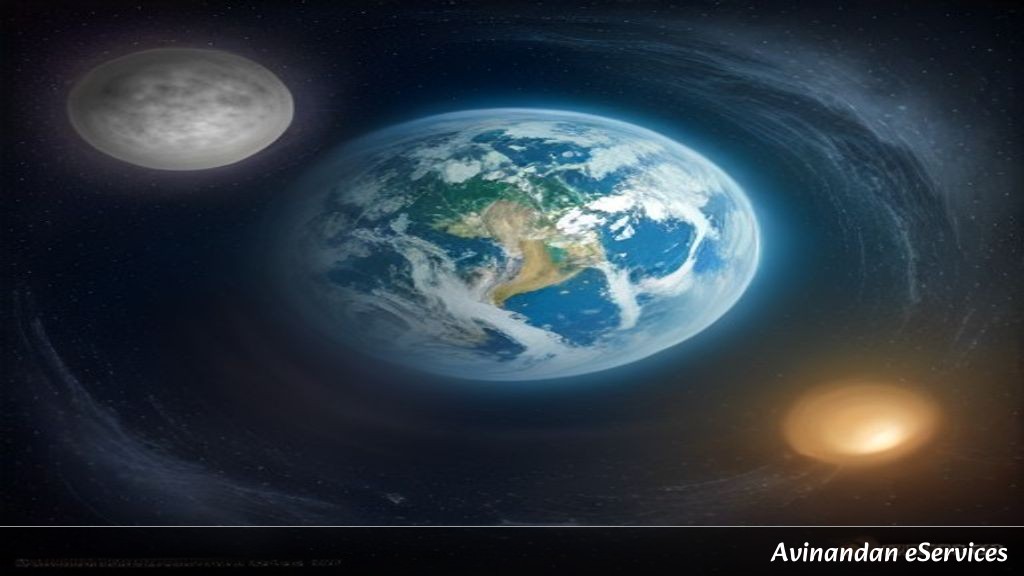
Unlike stars, some celestial bodies do not have their own heat and light. They are lit by the light of the stars. These bodies are called planets. The word 'planet' comes from the Greek word "Planetai," which means 'wanderers.' The Earth on which we live is a planet. It gets all its heat and light from the sun, which is our nearest star. If we look at the Earth from a great distance, say the moon, it will appear to shine just like the moon does.
4. The Solar System
The sun, eight planets, satellites, and some other celestial bodies known as asteroids and meteoroids form the solar system. We often imagine the solar system as a family, with the sun acting as the head.
- The Sun: Located in the center of the solar system, the sun is huge and made up of \textremely hot gases. It provides the pulling force that binds the solar system together and is the ultimate source of heat and light for the solar system.
- The Planets: There are eight planets in our solar system in order of their distance from the sun: Mercury, Venus, Earth, Mars, Jupiter, Saturn, Uranus, and Neptune. An easy way to remember this order is the sentence: "My Very Educated Mother Just Served Us Noodles." Mercury is the closest planet to the sun, while Neptune is the farthest.
- The Earth: Earth is the third nearest planet to the sun and the fifth largest planet in size. It is slightly flattened at the poles, which is why its shape is described as a geoid (meaning an Earth-like shape). Earth is the only planet known to support life because it has water, air, and moderate temperatures.
5. Satellites and Other Bodies
A satellite is a celestial body that moves around the planets in the same way as the planets move around the sun.
- Natural Satellites: The Earth has only one natural satellite, which is the moon. Its diameter is only one-quarter that of the earth. It moves around the earth in about 27 days.
- Asteroids: Apart from stars, planets, and satellites, there are numerous tiny bodies that also move around the sun. These bodies are called asteroids. They are found between the orbits of Mars and Jupiter.
- Meteoroids: Small pieces of rocks which move around the sun are called meteoroids. Sometimes these meteoroids come near the earth and tend to drop upon it, creating a flash of light as they burn up due to friction with the Earth's atmosphere.
Summary & Key Takeaways
Here is a quick recap of the important points from this chapter that students should remember:
- All objects shining in the night sky are called celestial bodies.
- Stars are celestial bodies that have their own heat and light (e.g., the Sun).
- Constellations are recognizable patterns formed by groups of stars (e.g., Saptarishi).
- There are eight planets in our solar system: Mercury, Venus, Earth, Mars, Jupiter, Saturn, Uranus, and Neptune.
- Earth is our unique home planet, supporting life due to the presence of water, air, and the right distance from the sun.
- The moon is Earth's only natural satellite, revolving around it in approximately 27 days.