Introduction: What is the Full Form of GST?
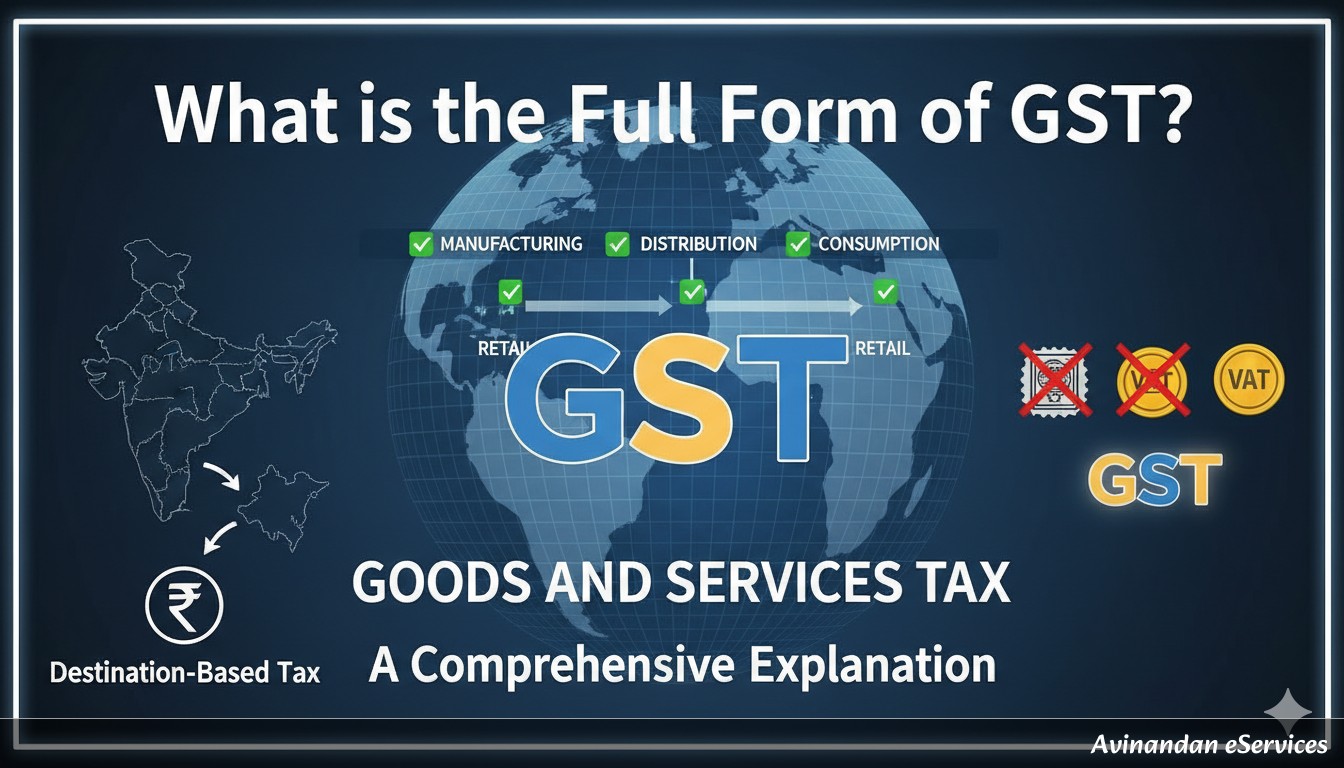
The full form of GST is Goods and Services Tax. It is a significant indirect tax reform that has transformed India's taxation landscape by unifying multiple central and state indirect taxes into a single, comprehensive tax system.. GST is levied on the supply of goods and services, aiming to create a unified national market and simplify the overall tax structure.
Detailed Breakdown of the Acronym
The acronym GST stands for:
- Goods
- Services
- Tax
This name accurately reflects its scope, as it encompasses taxes on both tangible products (goods) and intangible services..
History and Purpose
The concept of a unified Goods and Services Tax in India was first proposed in the year 2000 by the Atal Bihari Vajpayee government.. After years of deliberation, discussions, and constitutional amendments, the GST Act was passed by Parliament on March 29, 2017, and officially implemented across India on July 1, 2017..
The primary purpose behind the introduction of GST was to:
- Unify Indirect Taxes: Replace a multitude of indirect taxes levied by both the central and state governments, such as Value Added Tax (VAT), service tax, excise duty, entertainment tax, and octroi, with a single tax..
- Eliminate Cascading Effect: Prevent the 'tax on tax' phenomenon, where taxes were levied at multiple stages of production and distribution, increasing the final cost of goods and services. GST ensures that tax is levied only on the value addition at each stage, with provisions for input tax credit..
- Create a Common National Market: Foster a seamless and unified market by removing inter-state tax barriers, promoting free movement of goods and services across the country..
- Simplify Tax Compliance: Streamline the tax administration process through a robust IT system, enabling online registrations, returns, and payments, thereby reducing compliance costs and improving transparency..
- Reduce Tax Evasion: The transparent and technology-driven nature of GST aims to curb tax evasion and corruption..
Importance and Usage
GST is crucial for the Indian economy as it has fundamentally reformed the indirect taxation system. Its importance lies in its ability to:
- Boost Economic Growth: By reducing the overall tax burden, stimulating demand, and making Indian goods more competitive domestically and internationally..
- Enhance Ease of Doing Business: Simplifying tax procedures and creating a unified market reduces operational complexities for businesses..
- Increase Government Revenue: A wider tax base, improved compliance, and reduced evasion lead to higher tax collections, which can be utilized for public welfare and infrastructure development..
- Promote Transparency: The online, technology-driven system makes tax administration more transparent and accountable..
GST is applied to the supply of goods and services. India follows a dual GST model, meaning that tax is levied by both the central government (Central GST or CGST) and state governments (State GST or SGST) for intra-state transactions. For inter-state transactions, Integrated GST (IGST) is levied by the central government.. The tax rates are structured with different slabs (e.g., 0%, 5%, 12%, 18%, 28%), with recent reforms simplifying this to primarily four standard rates..
Frequently Asked Questions (FAQs) about GST
- What is the full form of GST?
The full form of GST is Goods and Services Tax.. - When was GST implemented in India?
GST was implemented in India on July 1, 2017.. - What is the main objective of GST?
The main objective is to create a unified national market with a single, simplified indirect tax structure, eliminating the cascading effect of taxes.. - Which taxes were subsumed under GST?
GST subsumed several indirect taxes, including VAT, central excise duty, service tax, additional customs duty, and octroi..