A Kitchen Mystery!
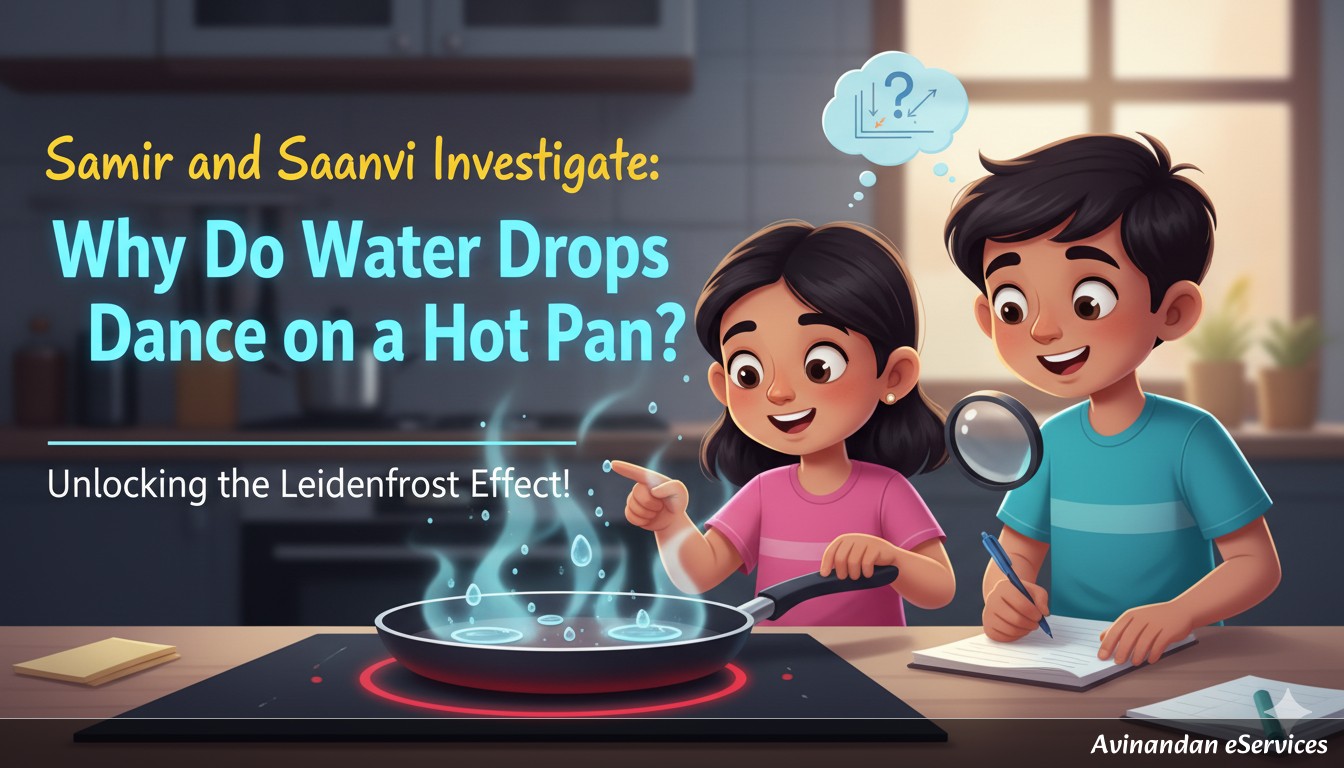
Samir: Saanvi! You won't believe what I saw! My dad was making dosas, and he sprinkled some water on the super-hot tawa to check the temperature. But instead of just sizzling away, the water drops turned into tiny little balls and started zipping and dancing all over the pan! They looked like tiny silver beads skittering around. How does that happen?
Saanvi: Oh, I love when that happens! It looks like magic, doesn't it? It’s not magic, though, it’s a really cool science phenomenon with an equally cool name: the Leidenfrost effect.
Samir: The Ly-den-frost effect? That sounds like the name of a character from a fantasy movie! What does it mean?
Saanvi: Haha, it does sound dramatic! It’s named after a German doctor, Johann Gottlob Leidenfrost, who studied it a long, long time ago. The effect is what happens when a liquid, like water, comes into contact with a surface that is much, much hotter than its boiling point.
A Cushion of Steam
Samir: Hotter than its boiling point? I know water boils at 100 degrees Celsius. So the pan was hotter than that. But why did the drops dance instead of just turning into steam right away?
Saanvi: Great question! You’d think it would evaporate instantly, right? But when the pan is significantly hotter than 100 degrees, something amazing happens. The very bottom layer of the water drop, the part that touches the pan, does flash into steam instantly. But it happens so fast that it creates a tiny, protective cushion of water vapor underneath the rest of the drop.
Samir: Wait a minute… a cushion of steam? You mean the water drop isn't even touching the hot pan? It’s floating?
Saanvi: Exactly! It’s like a tiny hovercraft gliding on a pocket of its own steam. That vapor layer is actually a poor conductor of heat, which means it acts as an insulator, protecting the rest of the water drop from the scorching hot surface of the pan. This is why the drop can survive for much longer—sometimes for a whole minute—before it finally boils away.
Samir: Wow! So that’s why it can move around so freely! It's not being slowed down by friction with the pan because it's literally floating on air... well, on steam!
Saanvi: You've got it! If the pan were only a little bit hot, say just at 100 degrees, the water would just bubble and sizzle away quickly. You need the surface to be much hotter to create that stable, protective steam layer. The specific temperature needed for this to happen is called the Leidenfrost point.
More Than Just a Kitchen Trick
Samir: So, this Dr. Leidenfrost just figured this out by making dosas?
Saanvi: Haha, probably not dosas, but he described it way back in 1751! And it’s not just a cool kitchen trick. Understanding the Leidenfrost effect is actually really important for scientists and engineers.
Samir: Really? How?
Saanvi: Well, think about things that get incredibly hot and need to be cooled down, like parts of a rocket engine or a nuclear reactor. Scientists need to understand this effect to design cooling systems that work properly. If the surface gets too hot, the Leidenfrost effect could prevent the cooling liquid from actually touching the surface, which would be a big problem! They have to manage the temperatures carefully.
Samir: Whoa, I never thought a dancing water drop on our tawa was connected to rockets and power plants! That is so cool.
Saanvi: It is! It just shows how science is hiding in plain sight all around us, even during breakfast prep. You just have to be curious enough to ask why things happen.
So, What Did We Learn Today?
Saanvi: Let's do a quick recap of our kitchen science discovery!
- The cool phenomenon of water drops dancing on a very hot surface is called the Leidenfrost effect.
- It happens when a liquid touches a surface that is significantly hotter than its boiling point.
- A layer of vapor instantly forms under the liquid drop, creating a protective cushion.
- This vapor cushion insulates the drop from the heat and allows it to float and skitter around without boiling away immediately.
- This effect is studied for important real-world applications, like designing powerful cooling systems.
Samir: So the next time I see water drops doing a dance on the tawa, I’ll know they’re just tiny hovercrafts floating on their own steam cushions. Science is awesome!