Introduction to Probability for RRB Exams
In the competitive landscape of Indian Railway Recruitment Board (RRB) exams, such as RRB NTPC (Non-Technical Popular Categories) and RRB Technician, the Mathematics section plays a pivotal role in determining a candidate's final merit. Probability is a fascinating and high-scoring topic within this section. It is the mathematical study of uncertainty and the likelihood of an event occurring.
Whether you are calculating the chances of drawing an Ace from a deck of cards or predicting the outcome of multiple coin tosses, Probability provides a structured framework to reach the correct answer. For RRB aspirants, mastering this topic is not just about memorizing formulas but about developing a logical mindset to analyze sample spaces and outcomes efficiently.
Topic Weightage and Importance
In RRB NTPC (CBT-1 and CBT-2) and RRB Technician Grade I & III exams, Probability typically accounts for 1 to 3 questions. While the number might seem small, in an environment where even 0.25 marks can make or break your selection, these questions are critical.
The difficulty level usually ranges from easy to moderate. Questions are often based on standard scenarios like coins, dice, playing cards, and colored balls. If your concepts are clear, you can solve these questions in less than 30 seconds, saving valuable time for more complex topics like Geometry or Data Interpretation.
Key Concepts and Formulas
To solve Probability questions accurately, you must understand the following terminology and core formulas:
- Experiment: An operation which can produce some well-defined outcomes.
- Sample Space (S): The set of all possible outcomes of an experiment. For example, in a coin toss, S = {Head, Tail}.
- Event (E): A subset of the sample space. For example, getting an even number on a die.
- The Basic Formula: The probability of an event E, denoted by P(E), is given by:
P(E) = (Number of favorable outcomes) / (Total number of possible outcomes) = n(E) / n(S) - Range of Probability: The probability of any event always lies between 0 and 1 (0 ≤ P(E) ≤ 1). 0 means the event is impossible; 1 means it is certain.
- Complementary Event: P(E) + P(not E) = 1. Therefore, P(E') = 1 - P(E).
Common Scenarios and Sample Spaces
| Experiment | Total Outcomes [n(S)] | Details |
|---|---|---|
| One Coin | 21 = 2 | {H, T} |
| Two Coins | 22 = 4 | {HH, HT, TH, TT} |
| Three Coins | 23 = 8 | {HHH, HHT, HTH, THH, TTH, THT, HTT, TTT} |
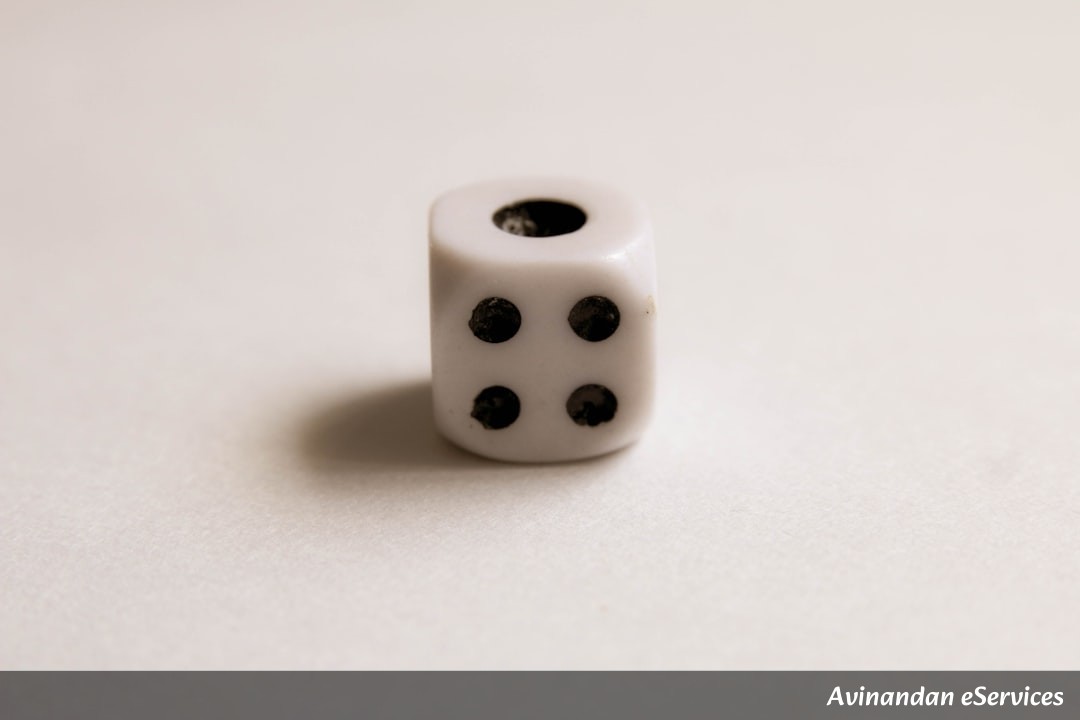
| One Die | 61 = 6 | {1, 2, 3, 4, 5, 6} |
| Two Dice | 62 = 36 | (1,1) to (6,6) |
| Deck of Cards | 52 | 4 suits (13 cards each), 2 colors (Red/Black) |
Solved Examples (Step-by-Step)
Example 1: Two coins are tossed simultaneously. What is the probability of getting at least one head?
Step 1: Find n(S). For two coins, S = {HH, HT, TH, TT}. So, n(S) = 4.
Step 2: Find n(E). The event "at least one head" includes HH, HT, and TH. So, n(E) = 3.
Step 3: Apply the formula. P(E) = n(E) / n(S) = 3/4 or 0.75.
Example 2: A card is drawn at random from a well-shuffled pack of 52 cards. What is the probability that the card drawn is a King or a Queen?
Step 1: Find n(S). Total cards = 52. So, n(S) = 52.
Step 2: Find n(E). There are 4 Kings and 4 Queens in a deck. Total favorable outcomes = 4 + 4 = 8. So, n(E) = 8.
Step 3: Apply the formula. P(E) = 8 / 52. Simplifying by 4, we get 2/13.
Example 3: A bag contains 5 red, 3 blue, and 2 green balls. If one ball is drawn at random, what is the probability that it is not blue?
Step 1: Find n(S). Total balls = 5 + 3 + 2 = 10. So, n(S) = 10.
Step 2: Find n(E). The ball is NOT blue, meaning it must be Red or Green. Favorable = 5 (Red) + 2 (Green) = 7. So, n(E) = 7.
Step 3: Apply the formula. P(E) = 7/10.
Common Mistakes to Avoid
- Miscounting the Sample Space: Students often forget that in a two-coin toss, 'HT' and 'TH' are two distinct outcomes.
- Confusing "At Least" and "At Most": "At least one" means 1 or more. "At most one" means 1 or zero. Read the question carefully!
- Not Simplifying Fractions: RRB options are always in the simplest fractional form. Always check if your answer can be reduced (e.g., change 4/8 to 1/2).
- Ignoring Card Composition: Forgetting that an Ace is not a face card (Face cards are King, Queen, Jack). There are only 12 face cards in a deck.
Practice Questions with Solutions
- What is the probability of getting a sum of 9 when two dice are thrown?
- A bag contains 6 white and 4 black balls. Two balls are drawn at random. Find the probability that they are of the same color.
- A number is chosen at random from the first 20 natural numbers. What is the probability that it is a prime number?
- In a single throw of a die, what is the probability of getting a number greater than 4?
- What is the probability that a leap year has 53 Sundays?
Solutions:
1. Solution: n(S) = 36. Favorable outcomes for sum 9: (3,6), (4,5), (5,4), (6,3). n(E) = 4. P(E) = 4/36 = 1/9.
2. Solution: n(S) = 10C2 = (10*9)/(2*1) = 45. n(E) = (6C2) + (4C2) = 15 + 6 = 21. P(E) = 21/45 = 7/15.
3. Solution: n(S) = 20. Primes up to 20: {2, 3, 5, 7, 11, 13, 17, 19}. n(E) = 8. P(E) = 8/20 = 2/5.
4. Solution: n(S) = 6. Numbers > 4 are {5, 6}. n(E) = 2. P(E) = 2/6 = 1/3.
5. Solution: A leap year has 366 days = 52 weeks and 2 \textra days. These 2 days could be (Sun,Mon), (Mon,Tue), (Tue,Wed), (Wed,Thu), (Thu,Fri), (Fri,Sat), or (Sat,Sun). Total 7 pairs. Favorable (having a Sunday) = 2. Ans: 2/7.
Frequently Asked Questions (FAQs)
1. Are Probability questions asked in RRB Group D as well?
Yes, though the frequency is lower than NTPC, basic probability questions regarding coins and dice are common in RRB Group D and Technician Grade III exams.
2. Do I need to learn Permutations and Combinations for Probability?
For basic RRB questions, simple counting works. However, for questions involving drawing multiple balls or cards, knowing the Combination formula (nCr) is very helpful.
3. What is the probability of an impossible event?
The probability of an impossible event is always 0. For example, getting a 7 on a standard six-sided die.
Conclusion and Final Tips
Probability is one of the most logical sections of the RRB Mathematics syllabus. To master it, focus on visualizing the sample space and understanding the constraints given in the question (like "without replacement" or "at most"). Practice with different types of problems—cards, dice, and balls—to build confidence. Remember, accuracy is key in RRB exams, so double-check your calculations. Keep practicing, stay consistent, and you will surely secure those \textra marks in your upcoming RRB NTPC or Technician exam. Good luck!