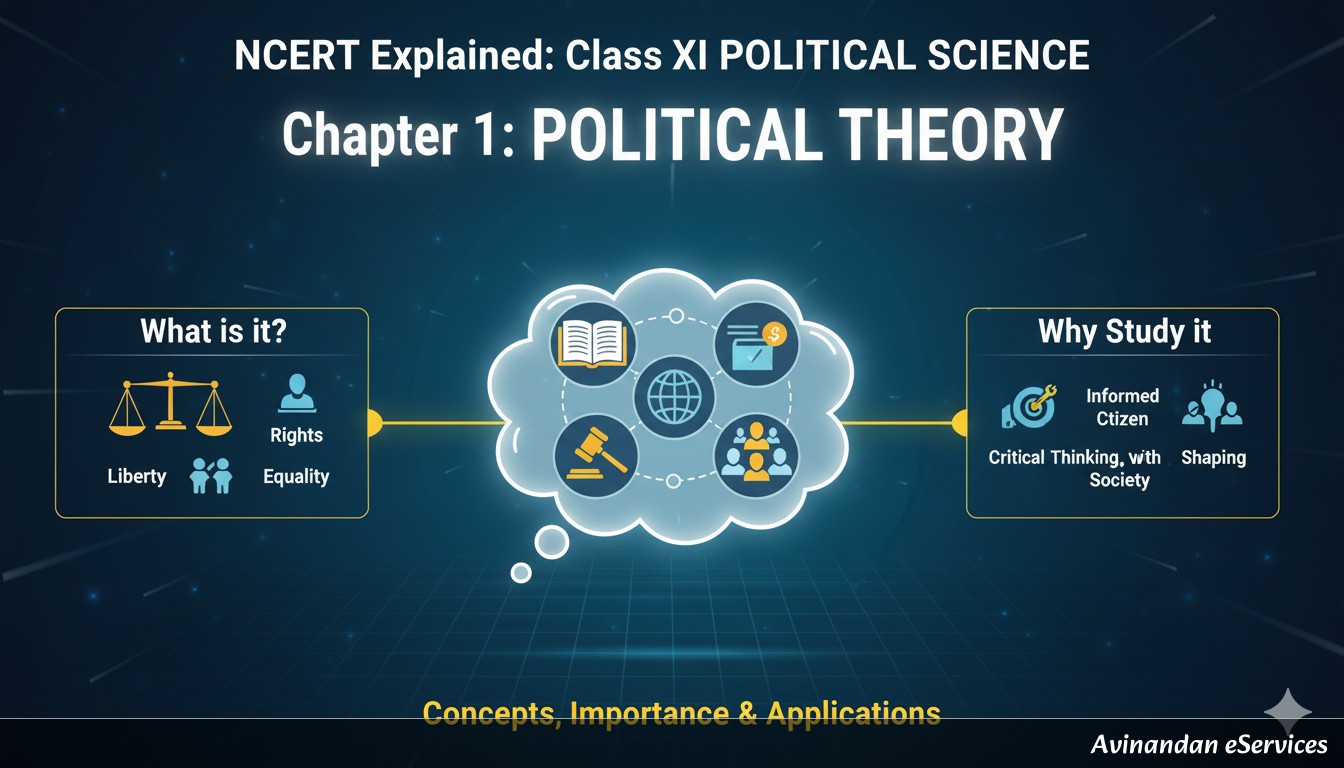
Introduction to the Topic
Welcome, students, to a fascinating journey into the world of ideas! When you hear the word 'politics', what comes to mind? For many, it conjures images of politicians giving speeches, heated debates on news channels, or the complex machinery of government. While that's part of the picture, it's not the whole story. Politics, at its heart, is about how we, as a society, make decisions together. It’s about the kind of world we want to live in and the rules we agree to follow. But how do we decide what is 'good' or 'just' for everyone? How do we balance the freedom of one person with the needs of the community? These are not simple questions, and they don't have easy answers. This is where Political Theory comes in.
This chapter from your Class XI NCERT textbook, "Political Theory: An Introduction," serves as a gateway to understanding the fundamental principles that underpin our political lives. It's not about memorizing facts or dates; it’s about learning to think critically about the values we hold dear—values like freedom, equality, justice, and democracy. Political theory encourages us to examine our own beliefs, understand where they come from, and engage in reasoned debate with others who may think differently. It equips us with the tools to be more thoughtful, engaged, and responsible citizens. So, let’s peel back the layers and discover what political theory is and, more importantly, why it matters so much in our daily lives.
Key Concepts Explained
What is Politics? De-mystifying a Common Word
Before we can understand 'political theory', we must first have a clear grasp of 'politics'. As mentioned, the common view of politics is often negative, associated with self-interest, manipulation, and power grabs. We often hear people say, "I'm not interested in politics," or "Politics is a dirty game." While it's true that politics can sometimes be disappointing, this view is incredibly narrow. Politics is a fundamental and unavoidable aspect of human society.
At its core, politics emerges from two basic facts of human life: first, we have diverse needs, interests, and visions of a good life. Second, resources—whether they be money, land, opportunities, or power—are limited. These differences and limitations lead to disagreements about how our collective life should be arranged. Politics is the process through which we negotiate these disagreements and arrive at collective decisions. It's the activity of managing conflict and cooperation within a society.
Think about it on a smaller scale. In your family, you might have disagreements about which TV channel to watch or what to have for dinner. You negotiate, compromise, or maybe your parents make a final decision for the good of the family. That’s a form of politics. In your school, there might be debates about the school uniform policy, the timing of exams, or the rules for the playground. Students, teachers, and the administration all have different perspectives, and they need a way to make a collective decision. That, too, is a form of politics.
At a larger level, governments engage in politics when they decide on policies. For example:
- Should the government build more hospitals or more highways?
- Should it increase taxes on the rich to fund welfare programs for the poor?
- Should there be reservations in educational institutions and government jobs?
- How should the nation conduct its relationship with other countries?
These are all political questions because they involve different groups with competing interests and values. Politics, therefore, is not just about what politicians do; it is about the collective action of a community aimed at promoting the common good while navigating diverse interests. As the great ancient Greek philosopher Aristotle noted, humans are 'political animals'. We live in communities, and our lives are intertwined. The decisions made by our society affect us all, and politics is the arena where these crucial decisions are made. So, to say you're not interested in politics is to say you're not interested in how the rules that govern your life are made.
What is Political Theory? From Ideas to Action
Now that we have a broader understanding of politics, what is 'political theory'? Simply put, political theory is the systematic reflection on the fundamental questions of our collective life. It deals with the ideas and principles that shape constitutions, governments, and social policies. It doesn't just describe the political reality as it is; it also asks what it ought to be.
Political theorists clarify the meaning of concepts we use all the time in political debates, such as freedom, equality, justice, rights, and secularism. Think about the word 'equality'. Does it mean everyone should be treated exactly the same? If a person in a wheelchair and an able-bodied person arrive at a building with only stairs, treating them 'equally' by giving neither any help would result in an unequal outcome. Political theory helps us probe deeper into these meanings, to understand that equality might mean providing equal opportunity, which sometimes requires different treatment (like building a ramp).
This tradition of thinking has a long and rich history. Thinkers from different eras and cultures have grappled with these questions:
- Plato and Aristotle (Ancient Greece): They discussed questions of justice and the ideal state. Is democracy the best form of government, or could a wise philosopher-king rule more justly?
- Jean-Jacques Rousseau (18th Century France): He famously wrote about freedom, arguing that true freedom lies in obeying laws that we ourselves have made as a community.
- Karl Marx (19th Century Germany): He argued that true equality could only be achieved if economic resources, not just political rights, were distributed fairly.
- Mahatma Gandhi (20th Century India): He reinterpreted the meaning of freedom (Swaraj) not just as political independence from the British, but as self-rule and self-control at an individual and community level. He also championed principles like non-violence (Ahimsa) and justice for the downtrodden.
These thinkers provide us with frameworks and vocabularies to think about our own political reality. Political theory is an ongoing dialogue across centuries. When we study it, we are not just learning about the past; we are engaging with ideas that are alive and relevant today, helping us make sense of contemporary issues like debates on citizenship, affirmative action, or environmental justice.
Unpacking the Core Ideas: Freedom, Equality, and Justice
Political theory revolves around certain core values that are fundamental to any society. Let's explore three of the most important ones: freedom, equality, and justice.
1. Freedom (Swatantrata)
Freedom is a powerful and cherished ideal. It is the cry of every nation struggling against colonialism and every individual fighting against oppression. But what does it truly mean to be free? Political theory tells us it's more than just the absence of \texternal constraints.
We often think of freedom as 'negative liberty' – the absence of interference. This means you are free to the \textent that no person or authority is preventing you from doing what you want to do. For example, freedom of speech means the state cannot stop you from expressing your opinions (within certain reasonable limits).
However, there's also the idea of 'positive liberty'. This refers to the capacity and opportunity to be the master of your own life. You might be legally free to get a good education, but if you lack the financial resources or if good schools are not available in your area, is your freedom to learn meaningful? Positive liberty suggests that for freedom to be real, society must provide certain enabling conditions, like access to education, healthcare, and employment.
Freedom is never absolute. We live in a society, not in isolation. My freedom to swing my arm ends where your nose begins. Therefore, some constraints are necessary to ensure that everyone can enjoy their freedom. For example, traffic laws restrict our freedom to drive however we want, but they are essential for creating a safe environment where everyone can travel. Political theory helps us debate and determine what constitute 'reasonable constraints' on our liberty.
2. Equality (Samanta)
The idea that all human beings are equal is a cornerstone of modern political thought. It's enshrined in our Constitution, which guarantees equality before the law. But like freedom, the meaning of equality is complex. It certainly doesn't mean that all people are the same in terms of their talents, abilities, or wealth. So what does political equality mean?
It primarily means three things:
- Political Equality: This means every citizen has equal political rights, such as the right to vote, contest elections, and criticize the government. The principle of 'one person, one vote, one value' is a classic example.
- Social Equality: This means the absence of discrimination based on caste, religion, race, or gender. It implies that every individual should have equal access to public facilities, employment, and education.
- Equality of Opportunity: This is perhaps the most crucial aspect. It means that everyone should have a fair chance to develop their potential and pursue their goals, regardless of their background. This is why governments implement policies like scholarships for underprivileged students or reservations for marginalized communities. The goal is not to treat everyone the same, but to compensate for existing social disadvantages to create a level playing field.
The debate in political theory is often about how far society should go to promote equality. Is it enough to provide equal opportunities, or should we also be concerned about massive inequalities in wealth and income? These are ongoing discussions that shape public policy.
3. Justice (Nyaya)
Justice is fundamentally about fairness. It's about giving each person what they are due. But what is 'due' to each person? This is a question that has been debated for centuries.
Political theorists have proposed several principles of justice:
- Principle of Treating Equals Equally: This is the most basic principle. It suggests that individuals who are similar in relevant respects should be treated similarly. For example, all workers doing the same job should receive the same wage, regardless of their gender or caste.
- Principle of Proportionate Justice: This principle suggests that it is fair to reward people in proportion to the scale and quality of their effort or contribution. For instance, a student who works harder and performs better in an exam deserves a higher grade.
- Principle of Recognition of Special Needs: This principle argues that justice also means taking into account people's special needs when distributing rewards or duties. A society that is just would not expect a person with a physical disability to perform the same physical tasks as an able-bodied person. Instead, it might provide them with special facilities or support. This is the basis of many social welfare policies.
A famous modern political philosopher, John Rawls, argued that a just society is one whose rules and institutions we would agree to if we were behind a 'veil of ignorance' – that is, if we didn't know our own position in society (whether we would be rich or poor, male or female, from a dominant or a marginalized community). He argued that from this position, we would choose rules that protect the most vulnerable members of society. This thought experiment shows how political theory helps us reason about what a truly just society would look like.
Why Should We Study Political Theory? Its Practical Relevance
After exploring these abstract concepts, you might still be wondering: Why should I, a student, study all this? What's the practical use? The answer is that political theory is not just for academics or politicians; it is for all of us. Here’s why it is incredibly relevant:
1. To Become Responsible and Informed Citizens
As citizens of a democracy, we are constantly asked to make political judgments. We vote for candidates, form opinions on new laws, and participate in public life. Political theory gives us the conceptual tools to do this thoughtfully. When a government introduces a new policy, studying political theory helps us analyze it not just based on our personal interests but through the lens of justice, equality, and freedom. It helps us understand the values at stake and make informed decisions that contribute to a healthier democracy.
2. To Think Systematically and Critically about Our Own Beliefs
We all have political opinions, but we rarely examine them systematically. We might feel that reservations are 'fair' or 'unfair', or that a certain tax is 'good' or 'bad'. Political theory encourages us to move beyond our immediate gut feelings and prejudices. It trains us to be precise about what we mean when we use terms like 'secularism' or 'development'. It teaches us to build logical arguments for our viewpoints and to be aware of the underlying assumptions we are making. This skill of critical thinking is valuable not just in politics, but in all aspects of life.
3. To Understand and Respect Different Viewpoints
Politics is about disagreement. People have different ideas about how society should be run. By studying political theory, we learn to understand the reasoning behind different political ideologies. We might not agree with a particular viewpoint, but we can learn to see why someone else might hold it. This fosters a sense of tolerance and allows for more meaningful and respectful public debate. Instead of simply shouting at each other, we can engage in rational discussion, which is the lifeblood of a democracy.
4. To Shape Our World and Fight for a Better Future
Ideas have immense power. The ideas of liberty and equality fueled the American and French Revolutions. The idea of social justice has inspired movements for civil rights and gender equality across the globe. The idea of Swaraj was central to India's freedom struggle. By studying political theory, we connect with these powerful ideas that have shaped history. It helps us understand the origins of our rights and freedoms and inspires us to protect them. It also equips us to identify injustice and to articulate our vision for a more just and equitable world. Whether it's arguing for environmental protection, advocating for gender justice, or fighting for the rights of the poor, political theory provides the language and the framework to turn our aspirations into reasoned arguments and effective action.
Summary & Key Takeaways
As we conclude this introduction to political theory, let’s recap the essential points. This field of study is far from being a dry, academic exercise. It is a vibrant and essential tool for understanding and shaping the world we live in.
- Politics is Everywhere: Politics is the fundamental process of negotiating disagreements and making collective decisions in society. It is not just about politicians but affects every aspect of our lives.
- Political Theory is Systematic Thinking: It is the disciplined reflection on the core values and principles that guide our political life, such as freedom, equality, and justice.
- It Clarifies Concepts: Political theory helps us understand the complex and often contested meanings of the political ideas we use every day.
- It has a Rich History: We engage in a dialogue with thinkers across centuries—from Plato to Gandhi—who have grappled with the same fundamental questions we face today.
- It is Highly Relevant: Studying political theory is crucial because it helps us become informed citizens, think critically about our own values, engage respectfully with others, and work towards building a better, more just society.
By engaging with the ideas in this chapter and the rest of your textbook, you are not just preparing for an exam; you are preparing for a lifetime of thoughtful and active citizenship. You are learning to ask the right questions and to think deeply about the kind of world you want to help create.