Introduction to the Topic
In the vast world of biology, one of the most fundamental questions we ask is: "How do we tell the difference between what is alive and what is not?" While movement is often a primary indicator, it isn't always obvious. A sleeping animal is still alive, and plants grow without visible movement. To truly define life, we look at Life Processes. These are the basic functions performed by living organisms to maintain their existence and repair their structures. Even when we are doing nothing—even when we are asleep—these maintenance processes continue to work. Without them, the molecular structure of an organism would break down over time due to the effects of the environment.
Chapter 6 of the Class X NCERT Science syllabus introduces us to these four critical pillars: Nutrition, Respiration, Transportation, and Excretion. These processes are interconnected. Energy is needed for these maintenance tasks, and that energy comes from outside the body in the form of food. This chapter explains how organisms take in energy, convert it into a usable form, move it to where it is needed, and get rid of the waste products created during these activities.
Key Concepts Explained
1. Nutrition: Powering the Body
Nutrition is the process by which an organism takes in food and utilizes it to get energy for growth, repair, and maintenance. Since life on Earth depends on carbon-based molecules, most of our food sources are also carbon-based.
- Autotrophic Nutrition: Green plants and some bacteria are autotrophs. They synthesize their own food using simple inorganic materials like carbon dioxide and water in the presence of sunlight and chlorophyll. This process is called Photosynthesis. The equation for photosynthesis is: 6CO2 + 12H2O + Sunlight/Chlorophyll → C6H12O6 + 6O2 + 6H2O.
- Heterotrophic Nutrition: Organisms that cannot make their own food and depend on autotrophs or other heterotrophs are called heterotrophs (animals, fungi). This includes Holozoic nutrition (taking in solid food, like humans), Saprophytic nutrition (feeding on dead matter, like fungi), and Parasitic nutrition (living on/in a host, like lice or tapeworms).
- Nutrition in Humans: The human digestive system is a complex alimentary canal. It begins at the Mouth (where salivary amylase breaks down starch), moves through the Oesophagus (peristaltic movements), to the Stomach (where HCl and Pepsin digest proteins), and then to the Small Intestine. The small intestine is the site of complete digestion, aided by bile from the liver and pancreatic juice. Small finger-like projections called Villi increase the surface area for absorption of nutrients into the blood.
2. Respiration: Releasing Energy
Taking in food is only half the battle; the body must then break down that food to release energy. This is called Respiration. It is often confused with breathing, but breathing is just the physical act of gas exchange, while respiration is the chemical process of releasing energy from glucose.
- Aerobic Respiration: Occurs in the presence of oxygen. Glucose is completely broken down into carbon dioxide, water, and a large amount of energy (ATP). This happens in the mitochondria.
- Anaerobic Respiration: Occurs in the absence of oxygen. In yeast, this produces ethanol and CO2 (fermentation). In our muscle cells, during sudden activity, it produces Lactic Acid, which can cause cramps.
- Human Respiratory System: Air enters through the nostrils, passes through the pharynx and larynx into the trachea (windpipe), and enters the lungs. Inside the lungs, the passage divides into smaller tubes ending in Alveoli. Alveoli are balloon-like structures where the actual exchange of gases (O2 and CO2) takes place between the air and the blood capillaries.
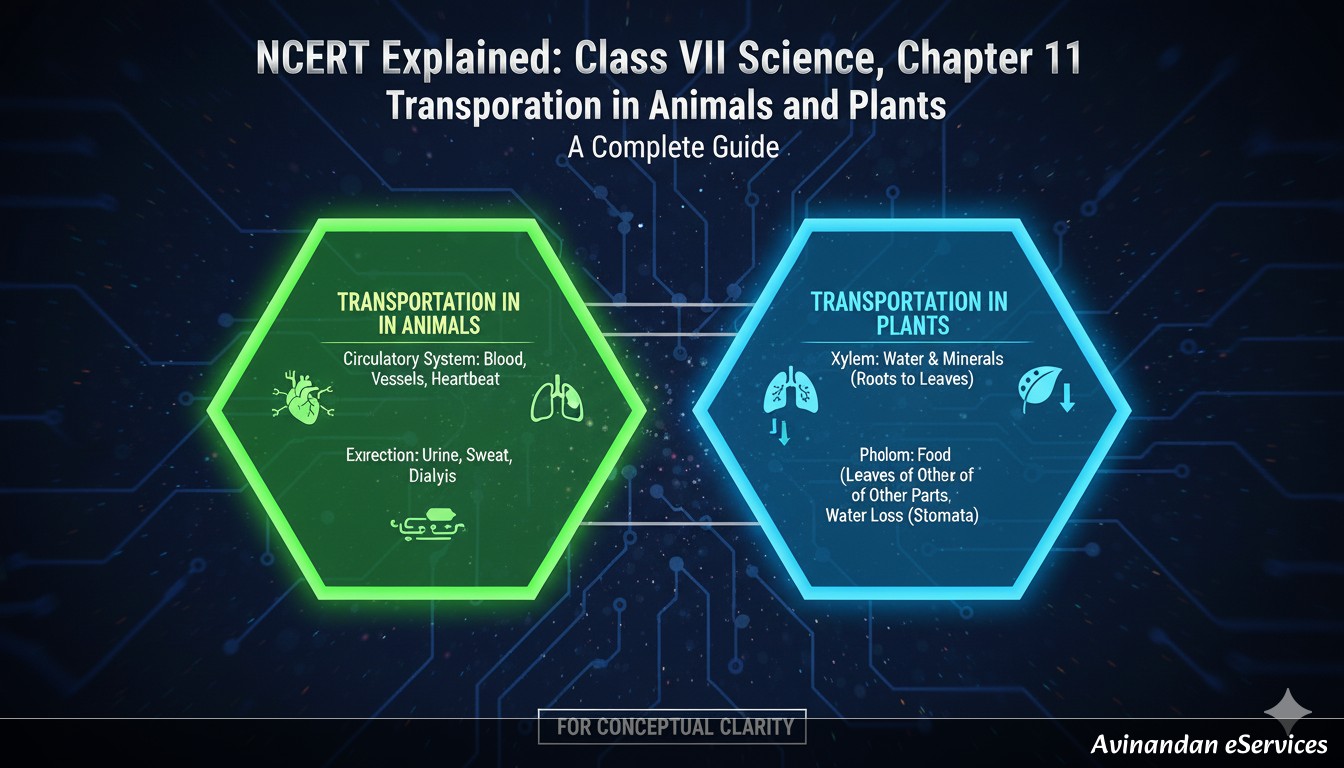
3. Transportation: The Body's Logistics
Once nutrients and oxygen are absorbed, they must be transported to every cell in the body. Similarly, waste products must be carried to the organs that remove them.
- Transportation in Humans: Our "transport system" consists of the heart, blood, and blood vessels. The Heart is a muscular pump with four chambers (two atria and two ventricles) to prevent the mixing of oxygen-rich blood and carbon dioxide-rich blood. Humans have Double Circulation, meaning blood passes through the heart twice for every one complete cycle of the body.
- Blood Vessels: Arteries carry oxygenated blood away from the heart (thick-walled), while veins carry deoxygenated blood back to the heart (thin-walled, with valves). Capillaries are the smallest vessels where exchange occurs.
- Transportation in Plants: Plants use two specialized tissues: Xylem transports water and minerals from the roots to the leaves (driven by transpiration pull), and Phloem translocates food (sucrose) from leaves to other parts of the plant (an active process using ATP).
4. Excretion: Waste Management
Chemical reactions in the body produce toxic by-products, like nitrogenous waste, which must be removed to prevent harm. This process is called Excretion.
- Human Excretory System: It consists of a pair of kidneys, a pair of ureters, a urinary bladder, and a urethra. The functional unit of the kidney is the Nephron. Nephrons filter the blood, reabsorbing useful substances like glucose and amino acids, while leaving behind urea and excess water to form urine.
- Excretion in Plants: Plants excrete waste in different ways. Oxygen is a waste product of photosynthesis. They lose excess water through transpiration. Other wastes may be stored in cellular vacuoles, shed with falling leaves, or secreted as resins and gums.
Summary & Key Takeaways
- Life Processes are essential maintenance functions: Nutrition, Respiration, Transportation, and Excretion.
- Nutrition provides the "fuel" (glucose) through autotrophic or heterotrophic means.
- Respiration converts that fuel into ATP, the energy currency of the cell.
- Transportation (Circulatory System/Xylem-Phloem) ensures every cell gets what it needs and removes what it doesn't.
- Excretion is the vital cleanup crew, removing toxic nitrogenous wastes via the Nephrons in the kidneys.
- Understanding these systems reveals the complexity and efficiency of the biological machinery that keeps us alive every second of the day.