Introduction to The Human Eye and the Colourful World
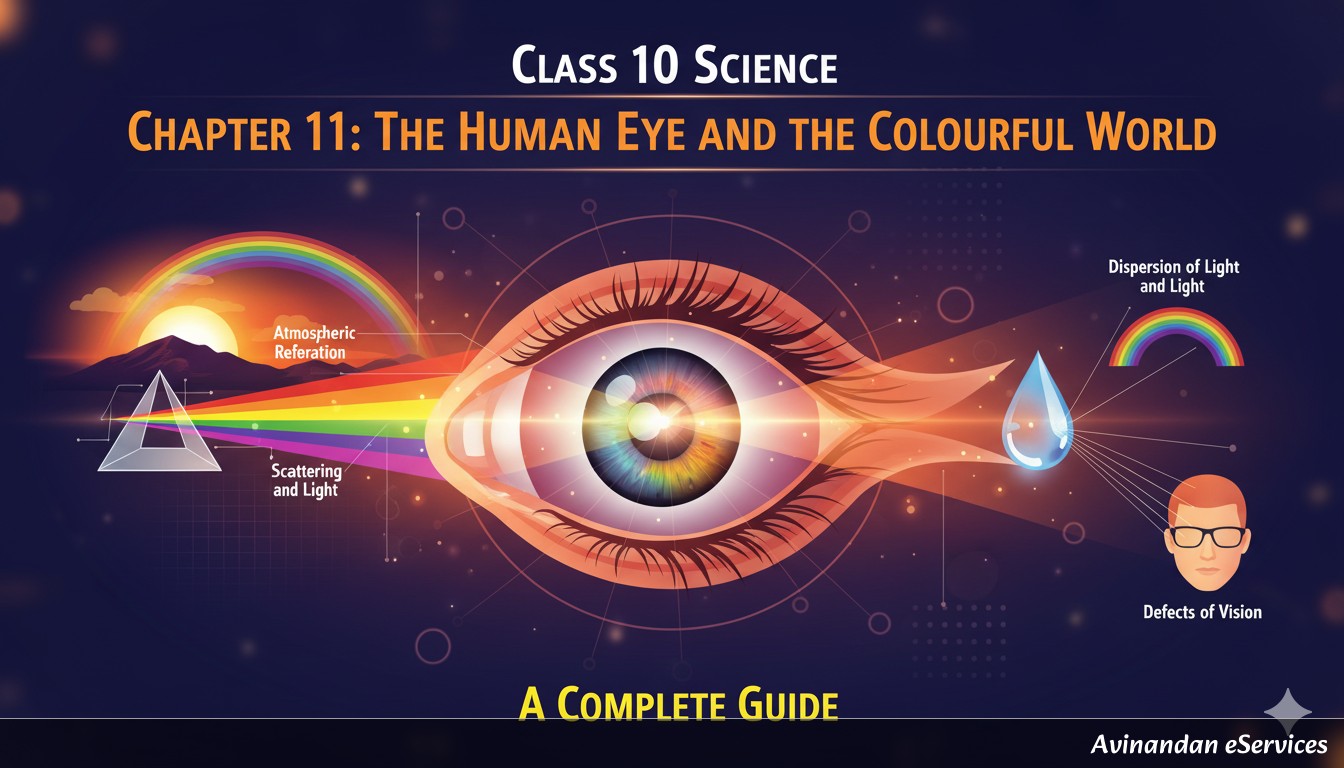
Welcome to this comprehensive guide on Chapter 11 of the NCERT Class 10 Science textbook, 'The Human Eye and the Colourful World'. This chapter is a fascinating exploration into the realms of optics, biology, and natural phenomena. It bridges the concepts of light we learned in the previous chapter with their real-world applications and occurrences. We begin by dissecting one of nature's most incredible optical instruments – the human eye. We will understand its intricate structure and how it enables us to perceive the vibrant world around us. The chapter then delves into common vision defects like myopia and hypermetropia, explaining not just what they are, but also how they can be corrected using lenses. Beyond the biology of vision, we will venture into the physics of light, exploring how prisms split white light into a beautiful spectrum – a phenomenon called dispersion. This knowledge will then be applied to understand the breathtaking formation of a rainbow. Finally, we will look up at the sky and unravel the mysteries behind the twinkling of stars, the advance sunrise and delayed sunset, and the iconic blue colour of the sky and the reddish hues of the sun at dawn and dusk. This chapter is crucial as it helps us appreciate the scientific principles governing both our sense of sight and the magnificent optical displays in nature.
The Human Eye: A Natural Optical Instrument
The human eye is a remarkable and sensitive sense organ. It functions much like a photographic camera, allowing us to see the objects and colours around us. It forms an inverted, real image on a light-sensitive screen called the retina. Let's explore its key components and their functions in detail.
Structure and Function of the Human Eye
The adult human eyeball is an almost spherical ball with a diameter of about 2.3 cm. Understanding its various parts is key to understanding how we see.
- Cornea: This is the transparent, bulging front part of the eye. Light entering the eye is first refracted by the cornea. It acts as the eye's main refracting surface, bending the light rays so that they can be focused. It also serves as a protective layer for the eye.
- Iris: Located just behind the cornea, the iris is a dark, muscular diaphragm. Its primary function is to control the size of the pupil, thereby regulating the amount of light that enters the eye. The colour of the iris is what we refer to when we state a person's eye colour (e.g., brown, blue, or green eyes).
- Pupil: The pupil is the small opening in the centre of the iris. It appears black because any light that falls on it enters the eye and is not reflected. In bright light, the iris contracts, making the pupil smaller to limit light entry. In dim light, the iris expands, making the pupil larger to allow more light to enter.
- Crystalline Lens (Eye Lens): Situated behind the pupil is the crystalline lens. It is a convex lens made of a transparent, soft, and flexible jelly-like material. Its main role is to provide the final, fine-tuned focusing of light onto the retina. The lens's curvature can be adjusted, which in turn changes its focal length.
- Ciliary Muscles: These muscles are attached to the eye lens and are responsible for changing its shape and, consequently, its focal length. When the ciliary muscles are relaxed, the lens becomes thinner, its focal length increases, and we can see distant objects clearly. When they contract, the lens becomes thicker, its focal length decreases, and we can focus on nearby objects.
- Retina: The retina is the light-sensitive screen at the back of the eyeball. It is a delicate membrane containing a vast number of light-sensitive cells called rods and cones. When light is focused on the retina, these cells get activated and generate electrical signals. Rods are sensitive to the intensity of light (dim light vision), while cones are sensitive to colour (colour vision).
- Optic Nerve: The electrical signals generated by the retina are transmitted to the brain via the optic nerve. The brain then interprets these signals, processing the information about the object's shape, colour, and position, and allows us to 'see' the object as it is (upright and in its actual size). The junction of the optic nerve and the retina is called the 'blind spot' as it has no photoreceptor cells.
Power of Accommodation
One of the most incredible abilities of the human eye is its power of accommodation. Accommodation is the ability of the eye lens to adjust its focal length to see both distant and nearby objects clearly. This is achieved by the action of the ciliary muscles. For a person with normal vision, the far point (the farthest point up to which the eye can see objects clearly) is infinity. The near point (the closest point at which an object can be seen clearly without strain) is about 25 cm. This distance is also known as the least distance of distinct vision (LDDV). The range of vision for a normal human eye is from infinity to about 25 cm. As people age, the eye lens loses its flexibility and the ciliary muscles weaken, which reduces the power of accommodation.
Defects of Vision and their Correction
Sometimes, the eye may gradually lose its power of accommodation. In such conditions, a person cannot see objects clearly and comfortably. The vision becomes blurred due to the refractive defects of the eye. Let's discuss the three common refractive defects of vision.
Myopia (Near-sightedness)
Myopia is a vision defect in which a person can see nearby objects clearly but cannot see distant objects distinctly. In a myopic eye, the image of a distant object is formed in front of the retina and not on the retina itself.
- Causes of Myopia: This defect arises due to either (i) excessive curvature of the eye lens (it becomes too convex or thick), or (ii) elongation of the eyeball. In both cases, the converging power of the lens increases, causing light from distant objects to focus before it reaches the retina.
- Correction of Myopia: Myopia can be corrected by using a concave lens of suitable power. A concave lens is a diverging lens. It diverges the incoming parallel rays from a distant object before they reach the eye lens. This makes the rays appear to be coming from the eye's far point. The eye lens can then easily converge these rays to form a clear image on the retina. The power of the required concave lens is calculated to bring the image of an object at infinity to the far point of the myopic eye.
Hypermetropia (Far-sightedness)
Hypermetropia is a vision defect in which a person can see distant objects clearly but cannot see nearby objects distinctly. The near point for a hypermetropic person is farther away from the normal near point (25 cm). In a hypermetropic eye, the light rays from a nearby object are focused at a point behind the retina.
- Causes of Hypermetropia: This defect arises due to either (i) the focal length of the eye lens being too long (the lens is too thin), or (ii) the eyeball having become too small. In both cases, the converging power of the lens is insufficient to focus the light from nearby objects onto the retina.
- Correction of Hypermetropia: Hypermetropia can be corrected by using a convex lens of appropriate power. A convex lens is a converging lens. It provides the \textra converging power required to form the image on the retina. The lens converges the rays from a nearby object before they enter the eye, so the eye lens can then focus them correctly onto the retina.
Presbyopia
Presbyopia is the defect of vision that occurs with ageing. The power of accommodation of the eye usually decreases with age. Most people find their near point gradually recedes away. They find it difficult to see nearby objects comfortably and distinctly without corrective eye-glasses. This happens because of the gradual weakening of the ciliary muscles and diminishing flexibility of the eye lens. Sometimes, a person may suffer from both myopia and hypermetropia. Such people require bifocal lenses for correction. A bifocal lens consists of both a concave part (upper portion, for distant vision) and a convex part (lower portion, for near vision).
Cataract
Another age-related condition is a cataract. In this condition, the crystalline lens of the eye becomes milky and cloudy. This leads to a partial or complete loss of vision. The only treatment for a cataract is surgery, where the opaque lens is removed and replaced with an artificial intraocular lens (IOL).
Refraction of Light Through a Prism
A prism is a transparent optical element with flat, polished surfaces that refract light. A common triangular prism has a triangular base and three rectangular lateral surfaces. These surfaces are inclined to each other. The angle between its two lateral faces is called the angle of the prism (A). When a ray of light passes through a glass prism, it gets bent twice – once when it enters the prism from the air, and again when it leaves the prism into the air. The peculiar shape of the prism makes the emergent ray bend at an angle to the direction of the incident ray. This angle is called the angle of deviation (D). It is the angle between the \textended incident ray and the emergent ray.
Dispersion of White Light by a Glass Prism
One of the most spectacular phenomena associated with a prism is the splitting of white light into its constituent colours. This is known as dispersion.
What is Dispersion?
When a narrow beam of white light (like sunlight) is passed through a glass prism, it splits into a band of seven colours. This band of colours is called a spectrum, and the phenomenon of splitting of light into its component colours is called dispersion. The sequence of colours observed is Violet, Indigo, Blue, Green, Yellow, Orange, and Red, which can be remembered by the acronym VIBGYOR.
The Cause of Dispersion
The cause of dispersion is that the refractive index of the prism material (like glass) is different for different colours (or wavelengths) of light. The refractive index of glass is maximum for violet light and minimum for red light. According to Snell's law, the amount of bending (refraction) depends on the refractive index. Since violet light has the highest refractive index, it bends the most, while red light, having the lowest refractive index, bends the least. Therefore, each colour emerges from the prism at a different angle, resulting in the formation of a spectrum.
Recombination of the Spectrum
Sir Isaac Newton was the first to use a glass prism to obtain the spectrum of sunlight. He then tried to split the colours of the spectrum further by placing another similar prism. However, he could not get any more colours. He then performed a crucial experiment. He placed a second identical prism in an inverted position with respect to the first prism. This allowed all the colours of the spectrum from the first prism to pass through the second prism. He found that a beam of white light emerged from the other side of the second prism. This observation showed that sunlight is indeed made up of seven colours and that a prism simply separates them. Any light that gives a spectrum similar to that of sunlight is often referred to as white light.
Rainbow Formation
A rainbow is a natural spectrum appearing in the sky after a rain shower. It is caused by the dispersion of sunlight by tiny water droplets present in the atmosphere. These water droplets act like small prisms. For a rainbow to be seen, the sun must be shining in one part of the sky, and it must be raining in the opposite part of the sky. An observer must stand with their back towards the sun. When sunlight enters a water droplet, it first gets refracted and dispersed. Then, it undergoes total internal reflection at the inner surface of the droplet. Finally, it gets refracted again as it comes out of the raindrop. Due to the dispersion and internal reflection, the different colours are sent back to the observer's eye along different directions, forming the arc of a rainbow.
Atmospheric Refraction
The Earth's atmosphere is not uniform. The air higher up is rarer (less dense), while the air closer to the Earth's surface is denser. As light from a distant object like a star enters the Earth's atmosphere, it has to travel from a rarer medium to a progressively denser medium. Therefore, the light continuously bends or refracts. This phenomenon is called atmospheric refraction. It is responsible for several interesting natural phenomena.
Twinkling of Stars
The twinkling of a star is due to the atmospheric refraction of starlight. Stars are very distant, so they act as point-sized sources of light. As the light from a star enters the Earth's atmosphere, it undergoes refraction continuously before it reaches the Earth. The atmosphere is not static; it has layers of hot and cold air that are constantly moving. The physical conditions of the atmosphere, like temperature and density, are always changing. The hotter air is less dense and has a slightly lower refractive index than the cooler, denser air. When starlight travels through these fluctuating layers, it gets refracted by different amounts from one moment to the next. The path of the light rays keeps changing slightly. This causes the apparent position of the star to fluctuate, and the amount of starlight entering our eye flickers – sometimes it looks brighter, and at other times, fainter. This continuous wavering is what we perceive as the twinkling of stars.
Why don't the planets twinkle?
Planets are much closer to the Earth and are thus seen as \textended sources, not point-sized sources. We can think of a planet as a collection of a large number of point-sized sources of light. The light coming from all these individual points also bends due to atmospheric refraction. However, the dimming effect produced by some points is cancelled out by the brightening effect produced by others. The total variation in the amount of light entering our eye from all these points averages out to zero. Therefore, the twinkling effect is nullified, and planets appear to have a steady glow.
Advance Sunrise and Delayed Sunset
The Sun is visible to us about 2 minutes before the actual sunrise and about 2 minutes after the actual sunset because of atmospheric refraction. Actual sunrise is when the Sun is at the horizon. When the Sun is slightly below the horizon, the light rays from the Sun have to travel from the vacuum of space (rarer medium) into the Earth's atmosphere (denser medium). As they do so, they bend downwards. Because of this continuous refraction, the rays appear to come from a position above the horizon. Therefore, we see the Sun about 2 minutes before it actually crosses the horizon. A similar effect occurs at sunset, where we continue to see the Sun for about 2 minutes after it has actually gone below the horizon. This effect increases the length of the day by approximately 4 minutes.
Scattering of Light
Scattering is the phenomenon in which light is redirected in many different directions when it interacts with particles in a medium. The colour of the scattered light depends on the size of the scattering particles and the wavelength of the light.
The Tyndall Effect
The Tyndall effect is the scattering of a beam of light by particles in a colloid or a very fine suspension. When a beam of light, like from a torch, enters a smoke-filled room through a small hole, we can see the path of the light. This is because the tiny smoke particles scatter the light, making its path visible. Similarly, the path of sunlight becomes visible when it passes through the canopy of a dense forest, scattered by tiny water droplets in the mist. The colour of the scattered light depends on the size of the scattering particles. Very fine particles scatter mainly blue light, while larger particles scatter light of longer wavelengths. If the particles are large enough, the scattered light may even appear white.
Why is the colour of the clear sky blue?
The blue colour of the sky is a beautiful example of light scattering. The molecules of air and other fine particles in the atmosphere are smaller than the wavelength of visible light. According to Rayleigh's law of scattering, the intensity of scattered light is inversely proportional to the fourth power of its wavelength. This means that shorter wavelengths are scattered much more strongly than longer wavelengths. In the visible spectrum, blue and violet light have the shortest wavelengths, while red light has the longest. When sunlight passes through the atmosphere, the fine particles in the air scatter the blue light (shorter wavelength) more effectively than the red light (longer wavelength). This scattered blue light enters our eyes from all directions in the sky, making the sky appear blue.
Why does the Sun appear red during Sunrise and Sunset?
During sunrise and sunset, the Sun is near the horizon. The sunlight has to travel through a much thicker layer of the Earth's atmosphere to reach our eyes than when the Sun is overhead at noon. During this long journey, most of the blue light and other shorter wavelengths are scattered away by the particles in the atmosphere. The light that reaches our eyes directly from the Sun is therefore depleted of blue, leaving predominantly the light of longer wavelengths, such as red and orange. This is why the Sun and the sky around it appear reddish or orange during sunrise and sunset.
Important Questions and Answers
Question 1: What is meant by power of accommodation of the eye?
Answer: The power of accommodation of the eye is its ability to adjust its focal length to form a clear and sharp image of objects at varying distances on the retina. This adjustment is performed by the ciliary muscles, which can change the curvature of the flexible eye lens. When viewing a distant object, the ciliary muscles relax, making the eye lens thinner and increasing its focal length. When viewing a nearby object, the ciliary muscles contract, causing the eye lens to become thicker and decreasing its focal length. This ability allows a person with normal vision to see objects clearly from their far point (infinity) to their near point (about 25 cm).
Question 2: A person needs a lens of power –5.5 dioptres for correcting his distant vision. For correcting his near vision he needs a lens of power +1.5 dioptre. What is the focal length of the lens required for correcting (i) distant vision, and (ii) near vision?
Answer: We know that the focal length (f) is the reciprocal of the power (P) of a lens, i.e., f = 1/P. The power is given in dioptres (D), so the focal length will be in metres (m).
(i) For correcting distant vision:
The power of the lens required, P₁ = –5.5 D.
The negative sign indicates that the lens is a concave lens, which is used to correct myopia (near-sightedness).
The focal length, f₁ = 1 / P₁ = 1 / (–5.5) m
f₁ ≈ –0.1818 m
To convert this to centimetres, we multiply by 100: f₁ = –0.1818 × 100 cm = –18.18 cm.
So, the focal length of the lens for correcting distant vision is –18.18 cm.
(ii) For correcting near vision:
The power of the lens required, P₂ = +1.5 D.
The positive sign indicates that the lens is a convex lens, which is used to correct hypermetropia (far-sightedness).
The focal length, f₂ = 1 / P₂ = 1 / (+1.5) m
f₂ ≈ +0.6667 m
To convert this to centimetres, we multiply by 100: f₂ = +0.6667 × 100 cm = +66.7 cm.
So, the focal length of the lens for correcting near vision is +66.7 cm. The person is suffering from presbyopia and requires bifocal lenses.
Question 3: Why does the sky appear dark instead of blue to an astronaut?
Answer: The blue colour of the sky on Earth is a result of the scattering of sunlight by the molecules and fine particles present in our atmosphere. This phenomenon is known as Rayleigh scattering. When sunlight enters the Earth's atmosphere, the shorter wavelengths (blue and violet light) are scattered more strongly in all directions than the longer wavelengths (red and orange light). This scattered blue light reaches our eyes, making the sky appear blue.
In outer space, there is no atmosphere. The region is largely a vacuum, meaning there are no particles to scatter the sunlight. Since there is no scattering of light, the light from the sun travels in a straight line without being dispersed into its constituent colours. An astronaut in space would see the sun as a brilliant white disc against a black background. The sky appears dark or black because there is no scattered light to reach their eyes from other directions.
Question 4: Explain why the planets do not twinkle.
Answer: The twinkling of celestial objects is caused by the atmospheric refraction of their light as it passes through the Earth's ever-changing atmosphere.
Stars twinkle because they are \textremely far away from us, appearing as point-sized sources of light. As the light from a star travels through the turbulent layers of our atmosphere, its path is continuously bent. This causes the apparent position of the star to fluctuate and the amount of light entering our eye to vary, which we perceive as twinkling.
Planets, on the other hand, are much closer to Earth. Because of their proximity, they do not appear as point sources but as \textended sources or small discs. We can consider a planet as a collection of a very large number of point-sized sources of light. While the light from each individual point source flickers due to atmospheric refraction, the effects from all the points across the planet's disc average out. The brightening effect from some points is cancelled by the dimming effect from others. This nullification of the flickering effect results in a constant amount of light entering our eye. Therefore, planets do not twinkle and appear to shine with a steady light.
Chapter Summary
Here are the key takeaways from 'The Human Eye and the Colourful World':
- The Human Eye: It is a natural optical instrument with parts like the cornea, iris, pupil, crystalline lens, and retina that work together to form an image.
- Power of Accommodation: The ability of the eye lens to adjust its focal length to see both near and distant objects clearly. The normal range of vision is from 25 cm (near point) to infinity (far point).
- Defects of Vision: Myopia (near-sightedness) is corrected using a concave lens. Hypermetropia (far-sightedness) is corrected using a convex lens. Presbyopia is the age-related loss of accommodation, often corrected with bifocal lenses.
- Refraction through a Prism: A prism bends light, and the angle between the incident ray and the emergent ray is the angle of deviation.
- Dispersion: A glass prism splits white light into its constituent spectrum of seven colours (VIBGYOR). This happens because the refractive index of glass is different for different colours.
- Rainbow: A natural spectrum formed by the dispersion of sunlight by water droplets in the atmosphere, which involves refraction, total internal reflection, and further refraction.
- Atmospheric Refraction: The bending of light as it passes through the Earth's atmosphere, causing phenomena like the twinkling of stars and advanced sunrise/delayed sunset. Planets do not twinkle as they are \textended sources of light.
- Scattering of Light: The redirection of light by particles in the atmosphere. This causes the Tyndall effect, the blue colour of the sky (due to scattering of shorter wavelengths), and the reddish appearance of the Sun at sunrise and sunset (due to the scattering away of blue light over a long path).